Decoding the Numbers: Wagering Requirements and Their Impact on UK Bettor Results
Written by Blake Müller · Sep 13, 2026

Decoding the Numbers: Wagering Requirements and Their Impact on UK Bettor Results
Promotions from UK bookmakers typically attach wagering requirements that dictate how many times a player must stake bonus funds before any winnings become eligible for withdrawal, and these conditions rest on straightforward arithmetic that multiplies the original amount by set factors ranging from 10x to 50x or higher depending on the offer structure. Observers note that such multipliers directly alter the expected value of any promotion because each required bet carries the built-in house edge of the chosen market, whether that is a football accumulator at 5 percent or a roulette spin at 2.7 percent, so the cumulative effect compounds the operator's statistical advantage over successive wagers.
Core Components of Wagering Calculations
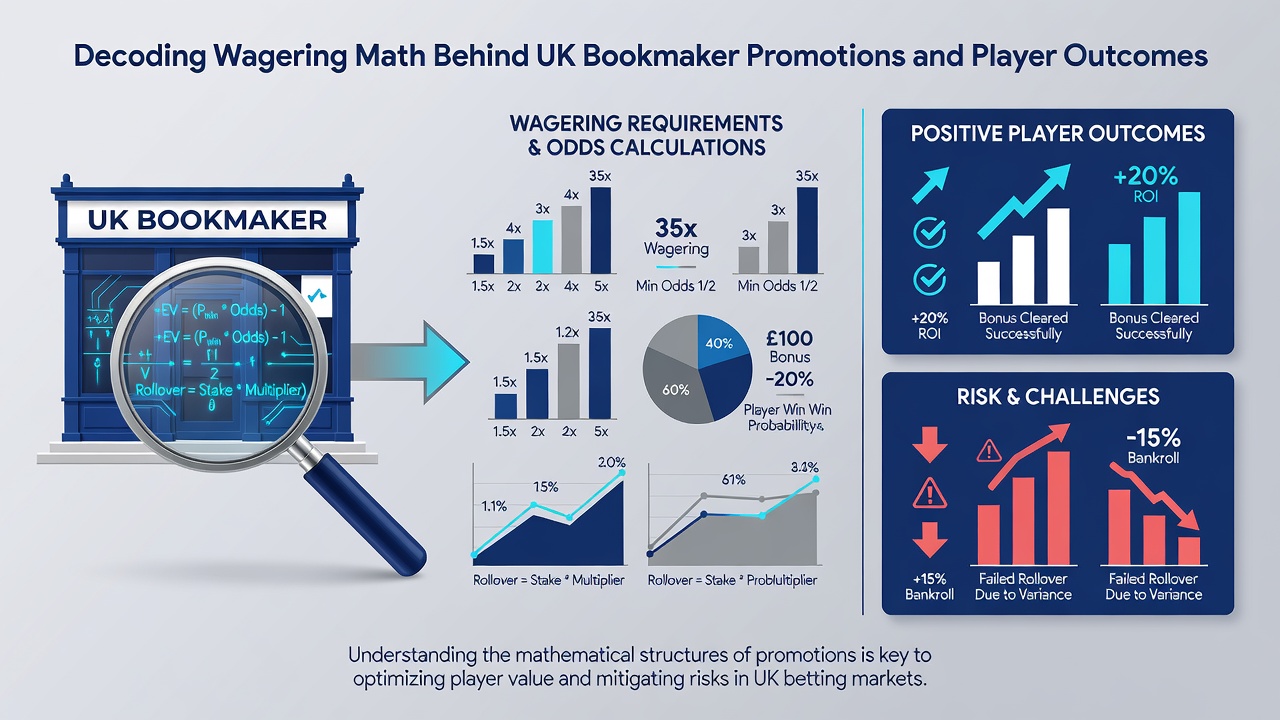
Bookmakers define wagering requirements through explicit terms that list qualifying bet types, minimum odds thresholds, and time windows for completion, while players encounter these rules most often on welcome bonuses, free bet tokens, and deposit matches issued during seasonal campaigns. Data from industry reports shows that a £10 bonus subject to 30x wagering demands £300 in total stakes before withdrawal becomes possible, yet the probability of reaching that threshold varies sharply with bet selection because higher-odds selections increase variance and lengthen the sequence needed to clear the target. Researchers at academic institutions have examined similar structures in other jurisdictions and found that the effective house edge on a promotion rises in direct proportion to the multiplier, turning a 3 percent edge on individual bets into a 90 percent drag on the bonus once the full requirement is applied.
Statistical Patterns in Player Completion Rates
Figures released in September 2026 by the Australian Gambling Research Centre indicated that only 12 to 18 percent of bonus recipients across comparable markets successfully met full wagering thresholds, with the remainder forfeiting remaining funds once time limits expired. Those who studied these outcomes observed that bettors who spread wagers across low-variance markets such as even-money propositions cleared requirements more frequently than those chasing higher-odds accumulators, although the latter group occasionally recorded larger payouts when sequences aligned. The same dataset revealed average completion times of 4.2 days for sports-focused offers and 6.8 days for casino-style promotions, highlighting how game selection influences both speed and success probability.
One case documented by analysts involved a £50 matched deposit carrying 40x wagering, which translated into £2,000 of required turnover; when players restricted activity to decimal odds between 1.5 and 2.0 the expected loss per £100 wagered stayed near £4, producing a projected net outcome of roughly minus £80 across the full cycle, whereas inclusion of longer-priced selections pushed the projected loss above £150 because variance extended the number of bets needed. Such examples illustrate how the mathematics remains consistent even as individual results fluctuate around the mean.
Regional Comparisons and Regulatory Contexts
Regulatory approaches outside the UK provide additional context for evaluating these mechanics. A 2025 report from the Nevada Gaming Control Board examined similar bonus structures and recorded that operators adjusted multipliers downward when average completion rates fell below 15 percent, suggesting market pressure can influence promotional design. Meanwhile the Canadian Centre on Substance Use and Addiction published findings in early 2026 that linked higher wagering thresholds to elevated player churn, noting that participants who encountered multipliers above 35x showed a 27 percent higher rate of account dormancy within 30 days of signup compared with those facing lower thresholds. These patterns align with observations from UK markets where operators publish terms that balance bonus generosity against the mathematical safeguards built into wagering conditions.
Additional layers appear when promotions combine free bets with deposit matches, because each component may carry separate multipliers and eligible market lists, forcing players to track multiple running totals simultaneously. Analysts point out that software tools provided by some platforms automatically calculate remaining requirements in real time, yet manual verification remains necessary to confirm that placed bets meet minimum odds and sport categories listed in the original offer.
Conclusion
The arithmetic governing wagering requirements therefore functions as a predictable filter that shapes both short-term engagement and longer-term retention metrics across the sector. Data continues to demonstrate that understanding multiplier effects, house-edge accumulation, and completion probabilities allows observers to map realistic outcomes without relying on promotional headline values alone, while ongoing research from multiple jurisdictions supplies fresh benchmarks for assessing how these structures evolve in response to player behaviour and regulatory oversight.